Apple swept the smartphone markets with its release and continued for years and ended the era of BlackBerry and Windows. Then Android phones began to spread globally, and then 2013 achieved a victory for Android by clearly outperforming iOS, and Google's system continued to spread strongly and became the official heir to Nokia devices in its spread and its share increased dramatically and achieved continuous breakthroughs. But recently, statistics have begun to appear, indicating that the age of leaps has ended and that the struggle of smart systems has begun to stagnate.
Personally, I prefer StatCounter statistics and studies because they are, in my view, the most accurate in practice. The site is primarily studying internet usage, not sales. And because we know that the definition of a smartphone as the device connected to the Internet, therefore, we should not consider any sales of offline devices. By analyzing smart systems, the graph appears as follows:
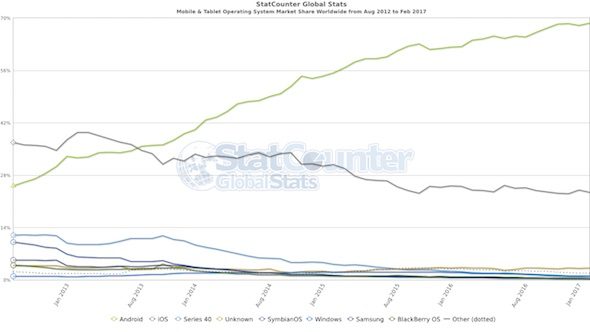
As you can see above, in August 2013 Android outperformed iOS in overall internet access. Google’s system continued its strong advance, while Apple continually regressed. But looking at Apple's graph during the past year and a half or two, we find that Apple has become almost stable and that the shares that Android gets are not from it, but from other systems. For example, January 2017, we find the percentage of 24% compared to 25% in January 2016, meaning that the total loss of Apple is approximately 1%. But by transferring the same figures for the previous year, “January 2015”, we find that the number was 30%, meaning I lost 5%.
In other words, the market has become stable in Apple's case.
Why do we see the recession beginning?
When you offer something strong and a quantum leap, it is natural that your sales will be exceptional and this is what happened with Apple in 2014 when it announced the iPhone 6 and 6 Plus and the sales were amazing and no company / system was able to grab market share from Apple almost. But the situation is different during 2015-2016.
Android: Whoever deals with Android up to 5.1 and then sees Android Nougat 7.0 will find a great paradigm shift, especially in the field of privacy and performance. Yes, neither company nor Google itself could claim that its device is faster than the iPhone, but the difference became less with time and Google respected privacy and the user agreed later and many changes.
Android companies: Before and until 2014, Samsung was playing almost alone so the user was comparing the Samsung S family to the iPhone. But during 2015/2016 there was a real competition. We saw Huawei precede the introduction of the P9 with a dual camera. We saw Xiaomi precede and advance a phone without the Mi Mix, and we saw Oppo even precede and offer a phone without the 3.5mm audio port. So, in theory, there are more options for iPhone buyers, not just the Galaxy S as before.

CamelIn contrast, Apple over the past two years has not made major leaps except in performance, processors and new hardware speeds. Yes, it opened its system better than before, but not with the same acceleration and pace of work Google. Then came the iPhone 7 without drastic changes.
So, in theory, it was assumed that Apple's sales would collapse more than achieved, and the share of Android would jump, right?
you comment
What was previously mentioned was a transfer of figures and statistics from several sources, which are found in the sources at the end of the article. We have an explanation for this and we will publish it in another article later because we want in this article for the comment to be for you. We will use comments and ideas in our next article. So tell us your opinion in the comments, and it should be noted that other systems share approximately 0.4%, i.e. negligible.
Note: The article does not mean that no one is leaving iOS or Android, but rather that there is great stability.
Has the conflict between smart systems ended and now all iOS and Android buyers will buy their system automatically? Tell us what you think
Sources:
gartner | StatCounter | statista




25 comment